Showing posts with label resource. Show all posts

Tuesday, December 30, 2008

should you exercise with a cold, redux

Last winter, as I was training for my first triathlon, I got a cold and wondered if it was smart to exercise while sick. At first, my web research said no, so I laid off. Then I got sick again and did more research and found evidence that said yes.

Specifically, it was Joe Friel's "neck check" to help decide to train while sick or not:
If you have above-the-neck symptoms, such as a runny nose or scratchy throat, start your workout, but reduce the intensity and duration. you may begin to feel better once you're warmend up, but if not, stop. If the symptoms are below the neck -- such as a sore throat, chest cold, chills, coughing up matter, achy muscles, or a fever -- don't even start. These are often the symptoms of a virus. Exercising will make it worse.
Now, Gina Kolata writes in the the NYTimes Personal Best section that studies have shown that exercise actually helps you down the road to recovery. Based on the results, this winter I'll keep pushing through when feeling ill (within reason).

Back to the proof: the decade-old studies asked two questions, 1) does a cold affect your ability to exercise, and 2) Does exercising when you have a cold affect your symptoms and recovery time?

Regarding one's ability to exercise:

At the start of the study, the investigators tested all of the subjects, assessing their lung functions and exercise capacity. Then a cold virus was dropped into the noses of 45 of the subjects, and all caught head colds. Two days later, when their cold symptoms were at their worst, the subjects exercised by running on treadmills at moderate and intense levels. The researchers reported that having a cold had no effect on either lung function or exercise capacity.

“I was surprised their lung function wasn’t impaired,” Dr. Kaminsky said. “I was surprised their overall exercise performance wasn’t impaired, even though they were reporting feeling fatigued.”

And in response to how exercise affects recovery time:

The investigators found no difference in symptoms between the group that exercised and the one that rested. And there was no difference in the time it took to recover from the colds. But when the exercisers assessed their symptoms, Dr. Kaminsky said, “people said they felt O.K. and, in some cases, they actually felt better.”

So, if you feel a cold coming on, do the neck check and keep going if it's all in your head. As Kolata points out at the end of her article, "too often taking time off because of a cold is the start of falling away from the program entirely."

Saturday, December 20, 2008

vascular surgeon says remove varicose veins

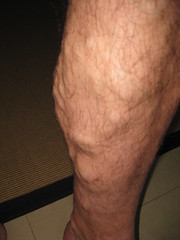
Last July, I went to my primary care physician to ask about the varicose veins that are popping out all over my left calf (seen clearly in this picture to the right). I was concerned they might be affecting my training and leading to the calf cramping earlier than it should (or worse: creating a clot that would break free and do some damage).

My insurance company wouldn't pay for a vascular surgeon back then, but since they've gotten worse, I finally got the referral to Dr. Singh yesterday to have a look-see.

As suspected, he said I have a text-book case of superficial varicose veins where the valves are just continuing to fail further and further down the vein network away from the original injury (behind my knee).

His concern is that during races and hard training, the combination of dehydration and the field of failed valves will be a breeding ground for blood clots, so the best course of action is to remove them.

The best news? It's an out-patient procedure that takes about an hour. Up until the surgery, I can train as normal and within a week of the procedure, I'll be able to be back training at normal intensity.

Details of the procedure to come in a future post (tales of phlebectomy and vein stripping and cauterization, oh my). Next stop: the ultrasound to identify the location of the "last good valve" is on January 9.

Saturday, December 13, 2008

prepping for 2009 race season

Although I haven't been blogging it, I've been busy getting ready for the 2009 race season over the last few weeks.

Since my last race, I've accomplished the following:
  • participated in the weekly Silicon Valley Triathlon Club track workouts at De Anza College (Tuesday nights at 6:30 if you'd like to try one) to work on my running speed
  • Joined the USA Triathlon club. I figure I'll make the money back on race entry savings... am already half way there because I...
  • Signed up for two "highlight" triathlons: 2009 Vineman 70.3 and 2009 Wildflower Olympic
  • Worked with my good friend Thom and Neil to come up with a comprehensive list of over 40 potential running races/triathlons/centuries/swims to do in 2009 (we won't do all, just the ones that make sense)
  • Finally got a referral to a vascular surgeon to get the varicose veins in my left calf examined. I found as the season went on, my left calf was the first to cramp and I'm hoping we can do something about it that won't sideline me too long. Appointment is Dec 19. Keep your fingers crossed for me
  • Got my Felt Z35 professionally fitted to me (wow!) AND gotten a serious bug to get a mountain bike so I can take advantage of all the non-paved roads around here for cross-training
Lots more to do. I'm taking it easy with just a couple workouts a week through Christmas and then I'll ratchet things back up again to hit my goals for 2009 (coming in my next post).

The best thing? I'm still having fun with all this, and I really like being in shape like I am.

Thursday, December 4, 2008

Screaming deal on Garmin Forerunner 305 thru 12/15

My lovely wife got me a Garmin Forerunner 305 as an early Father's Day present this year, and it is, hands down, my favorite gadget, and it really helped me to measure my progress over the year as I put in the miles and picked up speed.

Likes:
  • Customizable display
  • Alarms (distance/pace/HR)
  • Great tracking through multiple satellites
  • Quick-release system (sold separately) to use in running/biking bricks or races
  • Motionbased.com interface for online tracking and sharing of workouts (see my free motionbased account)
Dislikes
  • Form factor: it's a little bulky, but you get used to it
  • It's not waterproof so you can't wear it during the swim (doh!)
  • The mac interface isn't so grand, but this should affect you PC owners
Costco's got a deal on them for just $159.99 through December 15. (Back when I got mine, they were retailing for $250).

If you've been holding out on getting one, I highly recommend you get off the fence and go buy your Garmin Forerunner 305 now.

BTW, I have nothing to gain from this promotion other than to know others are enjoying the same cool technology I am.

Tuesday, November 18, 2008

1st track workout: Silicon Valley Tri Club

At last I was able to get a Tuesday free of work and family obligations to be able to take part in one of the regular Tuesday night track workouts put on by Coach Sherry for the Silicon Valley Triathlon Club (SVTC).

Since the workout is way down at De Anza College and begins at 6:30pm (you're supposed to warm up on your own beforehand), it's not the most convenient workout session to attend for me as I have to drive 20 miles in rush hour traffic to get there.

Despite all that, I made it tonight and given how much fun it was, I'll be sure to make it back again.

The workout itself was posted ahead of time to the SVTC mailing list (as they all are). I was a little nervous to attend because this was my first ever group track workout. Would I be fast enough? Would I stand out in my basic ignorance of all the lingo? (ABCs and IT bands and VDOTs, oh my).

I needn't have worried. I've got a strong enough base fitness that I was able to keep up fine and even enjoyed myself more than I thought I was going to. There were about 30 of us in all, and we split into two groups: the fast folks (not me) and the rest (including me).

Our workout (all running counter-clockwise around the track):
1 x 1600 @ T pace
Rest interval is core circuit #1
1 x 1200 @ T pace
Rest interval is core circuit #2
1 x 800 @ T pace
Rest interval is core circuit #3
1 x 400 @ T pace
Rest interval is core circuit #4
1 x 200 @ T pace
Rest interval is core circuit #5

Slow recovery x 800 (clockwise, to unwind) and stretch to end.
For me, T pace = 7:40 per mile and the core circuits were all variations on a set of situps/crunches, a set of lunges/squats and a set of planks/pushups.

The hour went by really quickly, and unlike when I run around the neighborhood on my own, I got a chance to work on speed AND get a core workout, too.

Even if I can't make the trip down to De Anza College on future Tuesdays, I'll be running the workouts down the street at Sequoia High School. I have a feeling this is how I'm going to bump up my speed on race days.

Saturday, October 4, 2008

Live Results from San Jose Rock-n-Roll Half Marathon

My good friend Matt points out this cool tool where you can follow any race participant's progress in real time:

http://www.liveraceresults.com/LiveElite/Default.aspx

My bib number is 6089

Monday, July 28, 2008

good reason to respect the swim

When I read that a triathlete died in the NY Triathlon during the swim leg, it only cemented the respect I have for being careful when wet in a triathlon.

Now, the NYTimes has published an article examining triathlon swim deaths -- not only the NY Triathlon death, but two more than came this past weekend (making 8 this year so far) and all of them have happened during the swim leg.

I've always joked with my friends that I like the swim leg the least of all the sports in triathlon because "it's the only leg in which I could die trying to finish it."
Any medical problem in the water is more likely to turn fatal than one that arises during a bike ride or a run. “Water is not a forgiving environment,” Dr. [Pamela] Douglas said. “It’s really hard when you’re swimming to sit down and say ‘I’m going to take a breather.’ ”
And it seems I'm not alone in my "respect" for the swim leg:

Many triathletes point to the swim as a triathlon’s most stressful segment. Most swims take place in open, often cold, water with hundreds or even thousands of other swimmers vying for position. “Nothing can prepare a newbie for the start,” said Russ Evenhuis, a triathlete in Olympia, Wash. “It can be like jumping into a washing machine. You will get swum over, kicked, hit and banged into.”

A triathlon’s open-water swim hardly resembles the pools where most triathletes train, said Neil Cook, a New York City based triathlete and coach. “There is no wall 25 yards away, you can’t see the bottom and the 50 to 150 people around you are more than you’ve probably swam with in total during your training,” he said. “Oh, and you are wearing this wetsuit that’s tighter than a girdle and you can’t breathe.” Raise your heart rate and blood pressure under these conditions, he said, and “any weakness you have will become apparent.”

I do know that since my first triathlon earlier this year, I've concentrated on becoming a stronger swimmer, and that's taken the edge off my concerns about the swim. But I think no matter how hard I train, I'll always look forward to T1 more than any other part of the race.

Tuesday, July 22, 2008

rock n roll half marathon discount via Twitter

Thinking of running the Rock 'n' Roll Half Marathon in San Jose on October 5?

If you still need to register for the race, you can save $20 by doing two easy things:
  1. register before July 31 deadline when the reg fee goes up by $10
  2. send a request via Twitter to @elite_racing for a $10 off coupon code.
Of course, if you already followed me on Twitter (I'm @itsthomas) you'd know this by now, and if you aren't already following @elite_racing, you're missing out on other race-related goodies.

I just registered for the RnR San Jose today, and it will be my first half marathon, ever. I figure this is as good a race as any to get me on the road to training for my first half Ironman next summer (I've got my eyes on the Vineman in July 2009).

Hope to see you in San Jose in July October!

Saturday, July 19, 2008

training with varicose veins

left calf and varicose veinsA few folks asked what, exactly, these varicose veins look like so here's a picture (right) that I took just an hour ago. The angle is my looking down from above and rotating my heel in so as to get a better shot of the side/back of the calf.

The spot of the initial injury is in the upper right part of the picture, and all the bumps and lumps you see throughout my calf are the result of cascading failures in the valves of my superficial veins.

What I learned from the Family Doctor web site completely gels with what I'm experiencing day in and day out:
All the leg veins have delicate valves inside them, which should allow the blood to flow only upwards (towards the heart), or from the superficial veins to the deep ones through the perforating veins. The valves protect against the head of pressure that would otherwise exist in the veins of the legs on standing. If there were no valves, there would be a pressure in the veins at the ankle equivalent to the height of the column of blood all the way up to the heart. It is this head of pressure that causes symptoms and damage when the valves stop working properly, as they often do in varicose veins. A valve occurs every five to ten centimetres in the main superficial veins of the legs.
It seems as if my calf is a battlefield of failed valves, and the more I think about it, the more this might explain why I've had such trouble with my calf cramping during swimming: there's reduced blood flow to the calf because of the failed valves, and with reduced blood flow, the cramping occurs. Hmmmm, I might be on to something that the insurance company may need to heed.

In any case, I'm now 100 hours into wearing my snazzy (not) knee-high compression sock, and me no like it. Never been a fan of tube socks, so you can imagine how much I'd enjoy having just one of my calves covered all day and night. Yes, I understand it's good for me, but having this thing gripping my calf 23 hours a day is annoying to say the least.

But, it's what the doctor ordered, so I'll keep wearing it. I just don't know if I'm ready to wear it while running/biking/swimming. It's rather a hideously nerdy looking thing.

Tuesday, July 15, 2008

varicose veins: cosmetic or catastrophic?


As I blogged previously, I had to visit the doctor yesterday to get the varicose veins in my left calf looked at by a professional.

I needed the doc to take a look before I plunked down even more registration fees for the events I want to do later this season (triathlons, half marathons, etc) on the off-chance that I'd be sidelined by a corrective procedure.

Little did I know my insurance would render my concerns moot.

I experienced a moment of sheer joy watching the computer-based records system ask "Are you sure?" when the nurse tried inputting my weight (189 lbs fully clothed), as the last time I'd seen the doc, in April 2007, I weighed a meaty 223 pounds. Yes, I've lost some weight!

Aside from that, however, I have to admit I'm none too pleased at the appointment.

My doc took a look at my left calf and examined it tactilely in comparison to my right calf and confirmed what I suspected: the bulging veins on my left calf are abnormal. But they're abnormal to the point that I heard him tsk as he found the veins all over the back of my calf as well as starting to pop up on the front of my leg.

When I asked if there was anything to be concerned about, he replied he needed to consult his colleagues to see who'd be best at taking the problem from here and left the examination room.

When he returned, he informed me that the next group who should see me are the vascular surgery team, but my (HMO) insurance wouldn't cover their procedure.

Long story short: if I want to take care of the problem, I'll have to pay out of pocket. If I'd rather just manage the problem (keep it from getting worse), it's simply a matter of wearing a compression sock 24 hours per day, indefinitely.

Great.

Given the predicament (rather: my refusal to pay out of pocket for corrective surgery), I peppered my doc with questions:

  • If I start training harder to complete a 70.3 race, will I endanger my health? no
  • Do I need be concerned a clot will develop that might be fatal? no
  • Will I find myself collapsing due to these varicose veins while training/racing? no
  • Is there anything I can do to keep this from getting worse? yes: wear compression socks
  • Is there anything I can do to make this better? yes: get surgery
  • What will it take to get my insurance to pay for the procedure? wear compression sock for six months or develop pain in the calf from the veins
So, now I'm wearing the compression sock (20-30 mg Hg) and paying close attention to whether or not I experience pain in the area.

And I'm studying up on varicose veins, too.

We'll see how long it takes before my calf starts to hurt.

Wednesday, June 4, 2008

intrigued by this power meter training thing

Ever since reading Your First Triathlon and following the training plan therein to help me finish my first triathlon, I've been a subscriber to Joe Friel's blog.

Joe's been talking a lot in his blog about using power meters to train better, and what he writes just makes plain sense to me. Today's post on the downside of power training includes this lovely rhyme when talking about trying to maintain speed into a headwind:
A watt is a watt. A mile-per-hour is not.
Until I start going long distances in my races (and have the time for the more involved training), I just can't see putting out that much money for a power meter (yet).

In the meantime, I'm appreciative of the frame through which to view my own training. In my own mind, at least, I think I'm moving from "I hope I finish" to "I hope I go faster."

Tuesday, May 27, 2008

dealing with muscle cramps

My calves and feet cramped up again this past weekend during the Masters swim workout.

It seems I'm not the only one suffering from muscle cramps, though. Joe Friel went into the latest research on why we cramp (mainly: we're not yet in shape. theoretically: dehydration, elecrolyte imbalance, poor biomechanics) and offered suggestions about how to deal with them yesterday over on his Trainingbible blog:
When you feel a cramp coming on there are two ways to deal with it. One is to reduce the intensity and slow down—not a popular option in an important race. Another is to alternately stretch and relax the effected muscle group while continuing to move. This is difficult if not impossible to do in some sports such as running and with certain muscles. Actually there is a third option which some athletes swear by—pinching the upper lip. Strange, but true.
Last Saturday, I managed to complete about 1500m of swimming before my left calf started to cramp up during the kicking part of our workout (about 400m behind the kick board). I tried stretching it out at the end of each length, but then the cramp moved to my foot and even to my big toe.

Heeding the advice I'd read just last week, I relaxed as much as I could and swam through (with) it. Ultimately, I wound up going 2100m, so it's not as if the cramping ended my session as it had before. I think I'm getting close to the source though: it's the kicking, stupid. Until joining Masters, I'd always cheated and barely kicked at all ("saving my legs for the bike/run"), but now the Masters program doesn't let me cheat, and I'm paying for it in the cramping.

Next time, I'll try pinching my upper lip to see if it helps.

Friday, May 2, 2008

best triathlon training books

I just got a package from Amazon with my latest triathlon training library additions, and I can't wait to dig in and learn how to take my training to the next level.

I feel like I've got a solid fitness base to work from, so now it's a matter of learning how to take it to the next level (especially if I'm going to aim for a half-Ironman by 2010).

So what's new on my reference shelves? These three paperbacks:
Lots to learn, and I'm glad to have the resources on my shelves now.

Thursday, April 24, 2008

resources for the beginner triathlete

Can't believe I was blind to the BeginnerTriathlete.com web site until just this week. Now I can't get enough of it.

The site's aimed, of course, at the beginner triathlete, and it's chock full of good stuff like
I'm almost embarrassed at how much sleep I lost devouring the content on the site last night.

Tempted to add my own "first race" experience to their collection, but I'll leave it here on the blog (for now).

Sunday, April 13, 2008

race day is finally here

Is today really the day? I can't believe this goal I set for myself six months ago is mere hours away from being achieved.

I'm wide awake and have been for about half an hour, well before my alarm was set to go off at 6am. The family's still sleeping and will stay that way (I hope) as I slip out the door to go to the course with a friend who's staying at the same hotel.

I've already fueled up by drinking a can of Ensure and eating a Power Bar. Now I'm drinking a bottle of water while blogging this last entry before the race. A couple observations from the last 24 hours of getting here and riding the road course:
  • NEVER let race day be the first time you go to the course. We got misdirected yesterday on our trip to the lake (4 miles from the hotel) and spent an extra 30 minutes finding the right entrance to the park. I'd have been more than a little pissed if we'd done the same dumb thing this morning.
  • My swim time's going to suck today: the level of the lake is really low, so the transition area (in the parking lot) is .32 miles from the shore. At normal levels, it looks like it'd only be a 100 yards from the shore. So, there's quite a bit of jogging in the wetsuit to be done today.
  • The bike course is very twisty. Looks like it's been swept recently, but still, I can imagine more than one person's going down as they try to navigate the corners.
  • I'm so glad I slept last night. Haven't slept well all this week, but last night, even in an unfamiliar bed, got a good 8 hours in and I'm ready to go.
Ok, time to post this and get on over to the transition area and check-in. Will blog my post-race experience later today.

Wish me luck!

Thursday, April 3, 2008

Tri Essentials for the Triathlete

As luck would have it, I happened to stop in at the Sports Basement in Sunnyvale tonight just as a special guest speaker, Dr Jennifer L. Forster, was beginning her talk on "Tri" Essentials in triathlon training.

I'd stopped in to rent a wetsuit for my race on April 13 (successful!!), and once I'd made the reservation, I stepped over to hear Dr Forster speak.

While she spoke to many topics around physical, nutritional and emotional support for triathletes, I was most interested in what she had to say about physical and nutritional topics.

According to Dr. Forster:
  • It takes three times as long to gain endurance as it does to lose it. Very much "use it or lose it" and this fact should be kept in mind if you're thinking about taking the winter off from training. It only takes a little bit of activity to maintain your endurance level, so don't just stop once the triathlon season's over.
  • Your aerobic fitness level is lost at a rate of 9% per week. So, what's taken you six months to build up can be lost in just ten weeks of stasis. Don't get injured!
  • If you try to start a triathlon exercise program AND start a diet at the same time, you'll fail at both. You can't starve yourself and try to build muscle at the same time. There's a reason the word "DIET" starts with the three letters D-I-E.
  • Building a strong immune system is the goal of any endurance athlete's (triathlete's) training program. It's built through Nutrition, Exercise, Chiropractics and Massage.
  • Rule of thumb on deciding what to eat: if it doesn't mold or go bad, don't eat it. Heck, if mold or bacteria won't eat it, why should you?
  • Instead of supplementing your diet with vitamins, etc, look into whole food supplements instead. You get all the nutrients without the sugar, salt, water or carbs.
  • Check out the site nutripoints.com to find out which food is most nutritious.
And, in regards to nutrition, Dr Forster gave some good tips on before, during and after the race.

Before the race (or long workout):
  • Eat nutritious food in the days leading up to the race (not just night before or day of)
  • Eat at least one hour before the even begins
  • Avoid rich, seasoned, fatty foods the day and night before
  • Best day-of meal: liquid carbohydrate-protein-based meal (liquid is absorbed easier)
  • IMPORTANT: test food products while training, not the day of the race.
During the race (or long workout):
  • Eat at intervals and eat the riht type of food
  • Maintain your energy stores -- the body has about one hour of energy stores
  • Food choices recommended: GU, energy bars, peanut butter pretzels, dried fruits
  • Find what food works for you during workouts and stick with it
  • Carry your own food. Don't rely on the race-provided food as it might disagree with you and hamper your performance. It's worth it to have to carry your own stuff to avoid accidentally consuming that disagrees with your system.
After the race (or long workout):
  • Eat small amounts of carbs, fruit, fruit juices in the 15 minutes just following the race.
  • Eat a meal with protein no more than two hours after the race is over
  • REST, RELAX, REJUVENATE after the race... your body needs it
  • If possible, take an ice bath to help speed up your recovery (get in a cool water bath and add ice, soak for 10 minutes, get out)
Above all else: hydrate all the time.

Unfortunately, I had to leave early, but the above advice was priceless for me. It's given me a lot to consider over the next ten days as I get ready for my first race.

Wednesday, April 2, 2008

runner's high is the real thing

Great story in the nytimes.com fitness and nutrition section about runner's high: experiments proving that euphoric feeling we get after hard exercise (not just running) is the real deal.

The runner’s-high hypothesis proposed that there were real biochemical effects of exercise on the brain. Chemicals were released that could change an athlete’s mood, and those chemicals were endorphins, the brain’s naturally occurring opiates. Running was not the only way to get the feeling; it could also occur with most intense or endurance exercise.

The problem with the hypothesis was that it was not feasible to do a spinal tap before and after someone exercised to look for a flood of endorphins in the brain. Researchers could detect endorphins in people’s blood after a run, but those endorphins were part of the body’s stress response and could not travel from the blood to the brain. They were not responsible for elevating one’s mood. So for more than 30 years, the runner’s high remained an unproved hypothesis.

But now medical technology has caught up with exercise lore. Researchers in Germany, using advances in neuroscience, report in the current issue of the journal Cerebral Cortex that the folk belief is true: Running does elicit a flood of endorphins in the brain. The endorphins are associated with mood changes, and the more endorphins a runner’s body pumps out, the greater the effect.

Now, having just recently involuntarily taken eight days away from training while suffering the flu, I know that it doesn't take enormous amounts of endorphins to boost the mood after exercise. Just doing the "easing back in" workouts this week has definitely contributed to my feeling happier. Not just the "thank goodness I'm no longer sick" happiness, but "wow, it's good to get out and on the road again!" happiness.

And we're just ten days from the race before the real high hits.

Saturday, March 29, 2008

Interval training to burn fat

Have been enjoying Matt's recent entry into the "my first tri" blogging world (he just did his first brick, congrats!), and he found an interesting workout style, called the "Tabata Intervals." In Matt's words:
Dr. Tabata discovered that fat-burning was more evident in a hard-core workout session for 4 minutes as opposed to an hour of steady-rate cardio. After a quick Google search of Tabata, I discovered that it has become the go-to exercise for weight-loss. Basically, a Tabata Interval can be done with weights or without.
A Tabata Thruster is where you hold two light dumbbells (max 15lbs) at your shoulders, you squat down, rise up and lift the dumbbells over your head. You do as many reps as you can for 20 seconds, break for 10 seconds, and then repeat 7 more times. Apparently this workout absolutely kills people. Here is an extreme example of the Tabata Thrusters, but it will show you how it's done:


Read the rest of Matt's post to find out about cardio-based Tabata Interval workouts. While intervals can help melt the pounds more quickly, it's still the long slow miles than increase my aerobic capacity overall. I think my cardio improvement is what's impressed me most in my ten weeks of training. Of course, now weighing 185 pounds (I lost six pounds this week while suffering the flu) is nothing to laugh at, either. Especially since I started this whole thing last summer weighing in at 220 pounds.

Thanks for digging the interval info up, Matt. Keep up the great work!

Tuesday, March 18, 2008

swim coaching really helps me relax

This past weekend, I had my first session with my swim coach, Tom, and boy was it worth every penny and minute of my day.

Tom emphasizes "body balance" in his teaching technique, and while I'd initially though I'd never make it through an hour-long session, the time wound up passing way too quickly for my liking.

Instead of jumping into the lanes to start swimming, we instead went over to the deep end so Tom could see how my body naturally floated in the water and then he guided me through several drills to help me learn how head position dictates how the rest of my body "hangs" in the water.

After a little while of kicking along with my arms hanging at my sides moving my head up and down in the water to get the positioning just right, Tom had me swim on one side to see how my body reacted when I'd turn my face up to get a breath of air.

I was rewarded the first couple times I tried to breathe with some water in the lungs, but I got the hang of it and learned to relax a lot more in the water and not try to rush my way through the breathing exercise.

Turns out that "relax while you're swimming" was my greatest lesson of the day, and one I've been able to put into practice in my two swims since the lesson. When I've relaxed, I've been able to go farther and faster and easier than ever before.

And I know this is going to be difficult to do during the race, but at least I've learned the lesson early.

Oh, and I did my second brick this past weekend: 55 min biking followed by 20 min running and I felt really good afterwards. No soreness like last time. Progress!

Wednesday, March 12, 2008

racing registration and tri club dues

On a tear this evening, finally getting around to doing the registrations I've been meaning to for a little while now. Items completed:
And, to top it all off, my first session with my swim coach is Saturday morning. Ready to learn how to move through the water better with his help, as he focuses on body balance in the water.

Onward and upward!